But for the maritime industry, this recovery does not signal a return to the old normal.
The recent crisis fundamentally changed how global chokepoints are perceived. It exposed just how fragile critical transit corridors can be, and how quickly localized disruption can ripple across the entire shipping network. Today’s challenge is no longer about water levels alone. It is about managing a global system that must be continuously reconfigured as new disruptions emerge elsewhere.
The Panama Canal crisis made one thing clear: route planning can no longer be static in a dynamic world.
Why the Panama Canal Crisis Changed Global Shipping
For decades, the Panama Canal was treated as a predictable constant in maritime planning. The drought years challenged that assumption. What began as a regional environmental issue quickly evolved into a global logistics problem, forcing carriers to reconsider long-established trade routes.
More importantly, the disruption revealed a deeper issue. Global shipping routes are tightly interconnected. When one chokepoint falters, pressure shifts immediately to others, amplifying congestion, cost volatility, and operational uncertainty across the system.
Even with the Canal operating at full capacity again, that structural vulnerability remains.
The 2026 Maritime Landscape: Permanent Strategic Shifts
Chokepoint Interdependency in Global Shipping
The Panama Canal can no longer be assessed in isolation. Shipping route planners increasingly consider multiple chokepoints, including Suez and alternative long-haul routes such as the Cape of Good Hope, whenever disruptions occur.
As a result, route selection has become a continuous decision-making process, shaped by real-time conditions rather than historical averages.
Predictive Budgeting and Cost Volatility
The introduction of more dynamic booking and pricing mechanisms in late 2025 has added another layer of complexity. Shipping costs are no longer just variable; they are increasingly difficult to justify without precise, data-driven reasoning.
In this environment, predictive budgeting depends on understanding not just where vessels are today, but how conditions are likely to evolve weeks ahead.
Resilience as a Competitive Baseline
During the drought years, carriers that adapted most effectively shared a common trait: agility. They were able to reassess routes, anticipate downstream impacts, and adjust operations faster than their peers.
In 2026, that level of agility is no longer a differentiator. It is the baseline requirement for maintaining profitability and service reliability.
From Static Reporting to Real-Time Maritime Scenario Modeling
One of the clearest lessons from recent years is that static reports age quickly. In a volatile maritime environment, insights are often outdated by the time they reach decision-makers.
To navigate this reality, maritime analysts need tools that allow them to model the world as it changes. This means moving beyond monitoring and toward continuous scenario evaluation.
Modern maritime planning is no longer about choosing the best route once, but about understanding the consequences of every alternative as conditions shift.
Turning Uncertainty into Strategic Advantage
This is where platforms like xyzt.ai play a growing role in the maritime analytics stack.
Rather than focusing solely on historical performance, the platform enables proactive, data-driven scenario modeling, including:
- Global route “what-if” analysis
Quantifying the time, fuel consumption, and emissions impact of shifting services between major canals or rerouting via the Cape of Good Hope. - Cross-source correlation
Overlaying AIS vessel movements with real-time weather conditions, draft forecasts, and port congestion data to identify emerging bottlenecks before vessels arrive. - Predictive ripple-effect analysis
Understanding how minor delays at one chokepoint can cascade through an entire schedule, enabling dynamic arrival planning and resource allocation weeks in advance.
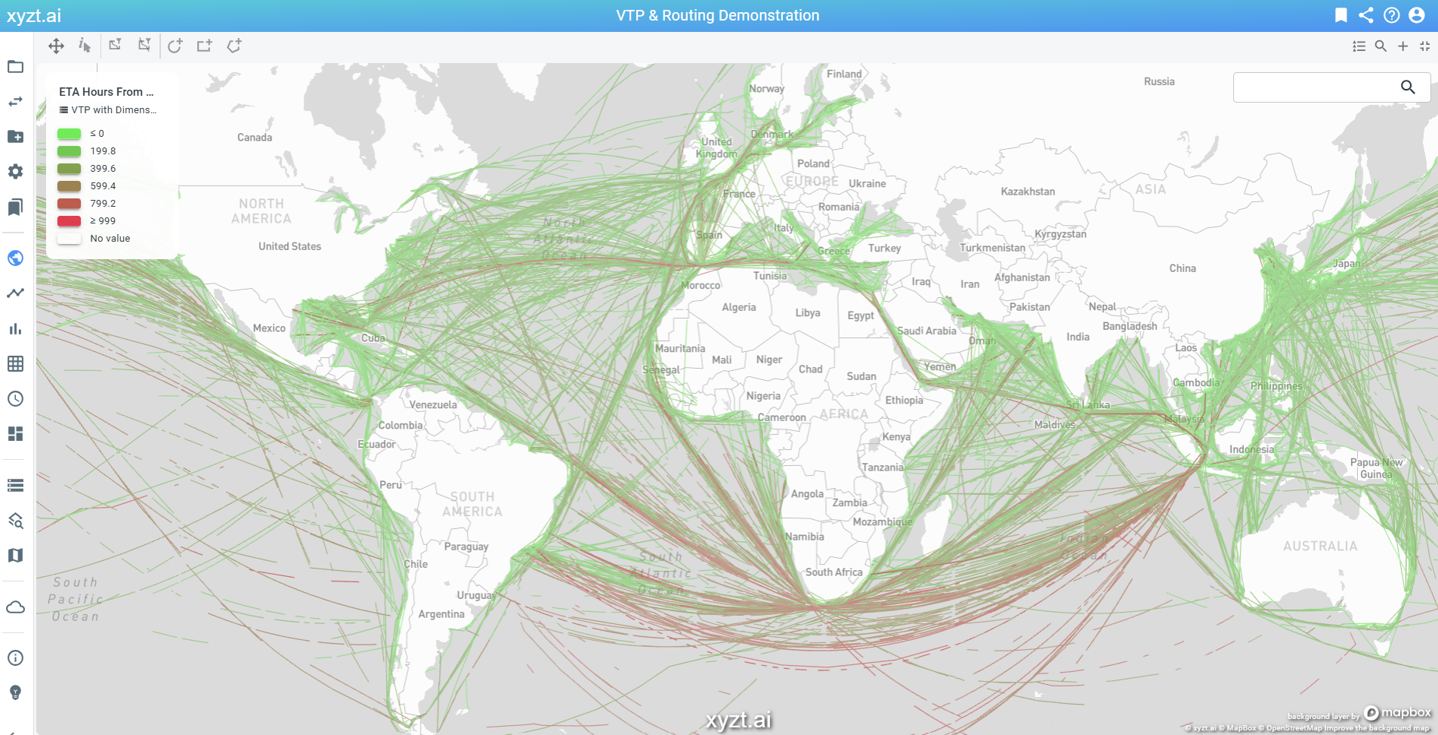
These capabilities help teams move from reactive decision-making to informed anticipation.
Find out more about how AIS data and related solutions empower maritime stakeholders to proactively incorporate predictive data into their workflows.
Volatility Is the New Constant in Maritime Logistics
The Panama Canal’s recovery is an important milestone, but it does not mark the end of uncertainty in global shipping. Instead, it reinforces a broader reality: volatility is now a permanent feature of the maritime landscape.
The organizations that perform best in this environment will not be those waiting for stability to return, but those equipped to operate effectively amid continuous change. Handling that complexity with clarity, speed, and less manual effort is no longer optional. It is central to how modern maritime operations are run.
You might also like:
Navigating Maritime Challenges with Data-Driven Insights
INEOS Phenol Antwerp Innovates on Maritime Safety with xyzt.ai and OOW to Prevent Ship Allisions