Maritime security has changed significantly in recent years. For defense organizations, coast guards, maritime authorities, and critical infrastructure operators, it is no longer enough to know where vessels are.
The real challenge is understanding what vessel behavior means.
That shift is creating new expectations for maritime intelligence solutions. Customers increasingly need to detect suspicious activity, understand historical movement patterns, combine multiple sources of information, and support faster operational decisions.
For system integrators, this creates both an opportunity and a challenge. The opportunity is clear: maritime customers need more advanced intelligence capabilities. The challenge is that building the analytical foundation for those capabilities is complex, costly, and difficult to deliver quickly.
In this article, we look at what is changing in the maritime security landscape, why analytics is becoming central to maritime domain intelligence, and how system integrators can accelerate delivery without rebuilding the full analytics stack themselves.
Maritime security now requires more than a map
Traditional vessel tracking remains important, but the operational context around maritime activity has become much broader.
Today, security teams need to understand vessel movements in relation to:
- Critical infrastructure such as pipelines, offshore wind farms, ports, cables, and terminals
- Strategic maritime corridors and shipping lanes
- Weather and environmental conditions
- Historical vessel behavior
- Satellite, radar, AIS, and other intelligence sources
- Operational zones, restricted areas, and suspicious deviations
AIS remains a valuable source of information, but it is only one part of the picture. In many security and intelligence use cases, the value comes from combining AIS with other datasets and turning that combined context into something analysts can investigate.
That is where maritime analytics becomes critical.
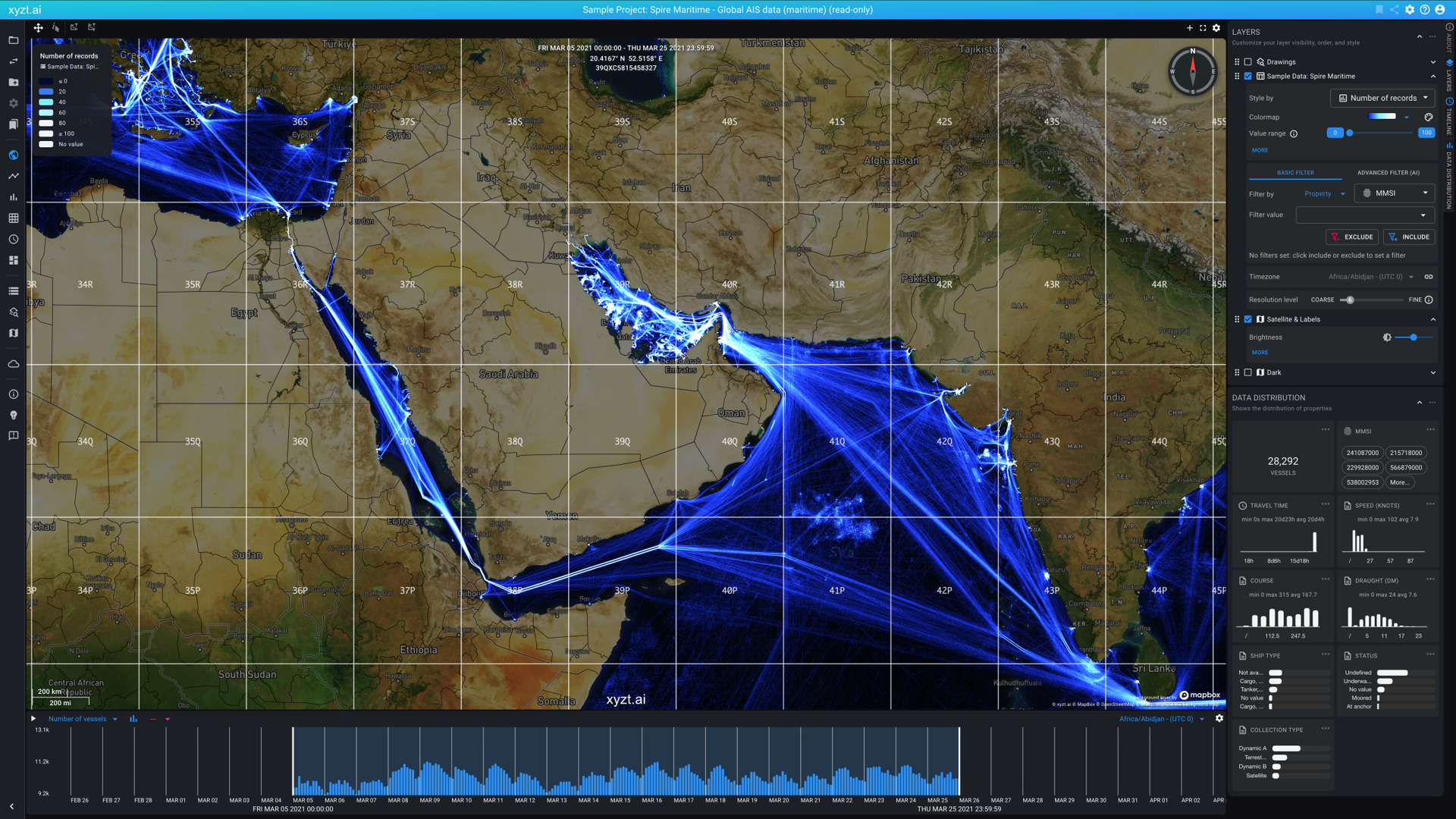
The goal is not simply to visualize more data. The goal is to help analysts move from large-scale movement patterns to specific events, vessels, locations, and behaviors that require further attention.
For a broader look at this shift, we also covered how maritime teams can move beyond vessel tracking and turn maritime data into intelligence.
Why maritime analytics is difficult to build from scratch
At first glance, maritime intelligence can look like a visualization problem. Put vessel positions on a map, add filters, and show a timeline.
In practice, it is much more complex.
To build a strong maritime analytics foundation, system integrators need to handle high-volume and high-velocity movement data. They also need to combine multiple intelligence sources, support interactive investigation at scale, enable advanced movement filters and spatial-temporal queries, and deploy in secure or constrained environments.
For defense and coast guard use cases, this often includes additional requirements such as on-prem deployment, air-gapped environments, intermittent connectivity, C2 integration, white labeling, and strict control over the end-user experience.
The visible mission application is only the top layer. Underneath that application sits the real technical challenge: a spatial-temporal analytics engine that can ingest, fuse, index, query, and analyze large volumes of movement and sensor data.
Building that foundation in-house can easily become a multi-year engineering effort. It adds cost, technical risk, and delay. For integrators, this can shift focus away from the mission solution and toward rebuilding core analytics infrastructure.
👉 Interested in watching the full webinar? You can download it here.
From global patterns to vessel-level investigation
A strong maritime intelligence solution needs to support multiple levels of analysis.
At the highest level, analysts may need to explore global or regional movement patterns across billions of AIS records. This helps identify density, traffic flow, busy corridors, and changes over time.
From there, analysts need to zoom into specific regions of interest. For example, key maritime corridors such as the Suez Canal or the Strait of Hormuz can be analyzed not only in terms of traffic density, but also routes, deviations, operational areas, and changes in behavior.
Finally, analysts need to move down to vessel-level investigation. This includes reviewing specific vessel movements, timestamps, positions, attributes, historical tracks, and replaying activity over time.
This ability to move from overview to detail is essential for maritime security, defense, and coast guard missions. It allows teams to investigate what happened, understand the context, and support more targeted operational decisions.
This is also where xyzt.ai’s visual analytics platform can support teams working with large-scale movement, sensor, and spatial-temporal data.
Three integration models for maritime intelligence solutions
The need for advanced maritime analytics appears in different types of projects. Based on our experience, there are three common integration models where system integrators and maritime technology providers can benefit from using an existing analytics foundation.
1. Embedded analytics in a defense C2 environment
In one defense integration scenario, the goal was to improve maritime domain awareness by adding historical movement context to real-time vessel tracking.
The solution needed to work inside an existing C2 environment, with limited and sometimes intermittent connectivity. It also needed to be deployed on board and integrated under the integrator’s own branding and user experience.
In this case, xyzt.ai was deployed on-prem and embedded into the existing defense solution. Historical movement data packages were added to provide context around vessel behavior, while real-time tracks were ingested and stored as a historical trace.
Because xyzt.ai supports standards such as OGC Web Map Service, the analytics layer could be integrated into the existing operational environment without requiring the integrator to rebuild the full stack.
The result was a stronger understanding of vessel movements, not only current positions, but also past behavior. For the integrator, the value was the ability to add advanced analytics while keeping ownership of the customer solution and customer relationship.
2. Multi-source maritime intelligence in a SaaS application
In another scenario, a software integrator needed to support maritime operations analysis across multiple government agencies.
The challenge was not only analytics. It was also the fragmented data landscape. Relevant information came from multiple sources, including AIS, satellite, weather, trade data, vessel ownership, and port call intelligence.
Rather than forcing users to switch between separate systems and screens, the goal was to bring these sources together into one analytical workflow.
Here, xyzt.ai was embedded as an analytical layer inside the integrator’s own SaaS application. The end user could work with multiple maritime datasets in one environment, creating a single source of truth for operational analysis.
This allowed the integrator to offer a cost-effective, multi-user maritime intelligence solution under their own application experience, while relying on xyzt.ai for the scalable analytics foundation.
3. Real-time IoT data as a customer-facing analytics service
A third use case involved a maritime IoT provider that deployed weather sensing devices on board vessels.
The company had valuable real-time data, but building a complete software analytics platform was not its core focus. Its expertise was in IoT technology and sensing, not in developing a full SaaS analytics product.
The goal was to turn real-time IoT data into customer-facing dashboards quickly. Fleet owners needed to see their own vessels, understand current conditions, and support operational decisions such as route planning.
Using xyzt.ai as the analytics and dashboarding layer, real-time data from IoT devices could be ingested through an API and turned into live, interactive dashboards. Reusable dashboard templates made it easier to onboard new customers without recreating the same dashboarding work each time.
For the IoT provider, this created a faster route to a software-enabled service. For its customers, it provided a real-time operational view of their own fleet.
What these use cases have in common
Although these examples differ in deployment model, data sources, and end-user needs, they share the same underlying pattern.
Partners want to move faster. They want to keep control of the customer experience. They want to offer advanced maritime intelligence capabilities without rebuilding the analytics foundation from scratch.
This is where xyzt.ai fits into the integration landscape.
Our platform acts as the spatial-temporal analytics layer inside broader maritime, defense, intelligence, and IoT solutions. It can support SaaS deployments, on-prem deployments, embedded workflows, white labeling, APIs, OGC services, and operational dashboarding.
The integrator or technology provider keeps ownership of the solution, the branding, the customer relationship, and the domain-specific application. xyzt.ai provides the analytics engine that makes large-scale movement and sensor data usable.
How system integrators can get started
Getting started with xyzt.ai is designed to be straightforward.
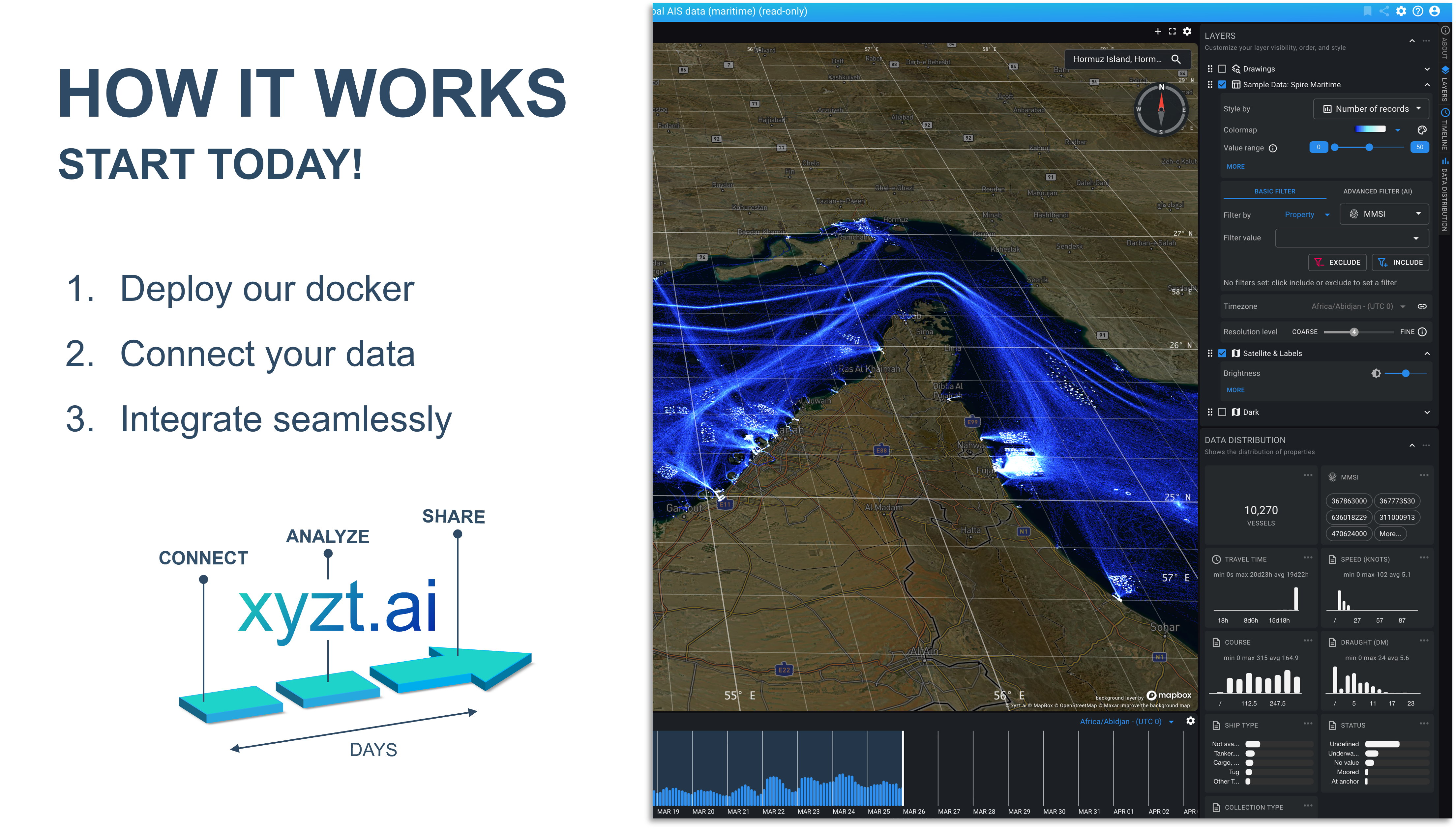
Depending on the project requirements, the platform can be deployed as SaaS or on-prem using Docker. Data ingestion is handled through an OpenAPI-compliant REST API. Integration can be done through embedding, authentication APIs, OGC services, and other API-driven workflows.
This makes it possible to move from data to operational analytics in days or months, not years.
For system integrators, that speed matters. Maritime security and intelligence requirements are evolving quickly. Customers are asking for more context, faster investigation, and stronger analytical capabilities. Competitors that can deliver faster have an advantage.
Building everything in-house may offer control, but it also introduces delay, cost, and risk. Using an existing analytics foundation allows integrators to focus on the mission solution and the customer-specific workflows that create real value.
You can learn more about the platform setup and integration approach on our How it works page.
Key takeaways
Maritime security is no longer just about tracking vessels. It is about understanding behavior, context, risk, and operational meaning.
To support that shift, maritime intelligence solutions need to combine multiple sources of information, analyze high-volume movement data, and support investigation across space and time.
For system integrators, the build-or-buy decision is becoming increasingly important. Building a spatial-temporal analytics foundation from scratch can take years. Embedding an existing analytics platform can shorten time to market, reduce technical risk, and help integrators focus on the mission application.
At xyzt.ai, we help partners turn maritime data, sensor data, and domain expertise into operational analytics. Whether the solution is deployed on-prem, embedded into a C2 environment, integrated into a SaaS application, or used to power customer-facing dashboards, the goal remains the same: help teams move faster from complex data to actionable intelligence.
Want to explore this with your own data?
If you are building maritime security, intelligence, defense, coast guard, or maritime IoT solutions, xyzt.ai can help you add scalable movement analytics without rebuilding the full stack.
You can explore the platform with existing datasets or work with us on a more specific use case using your own data.
Request a demo to see how xyzt.ai can support your maritime intelligence workflows.
You might also like
Beyond Vessel Tracking: Turning Maritime Data Into Intelligence